

Drones have become incredibly popular, and with that comes a need for clear ground rules for everyone's safety. Basically, the new drone regulations mean that as a pilot, you usually have to register, obtain a digital "license," and keep track of specific flight rules. This applies especially if your drone has a camera or weighs more than 250 grams.
Why were new drone regulations introduced in Sweden?
Drone flying has exploded from being a small hobby to something that both individuals and companies do daily. With thousands of drones in the air, it became obvious that we needed a common regulatory framework. Think of the airspace as a highway – without traffic rules, it would quickly become chaotic and dangerous for everyone.
The purpose of the EU-wide rules that now apply throughout Sweden is not to make things complicated, but to create a safe and predictable environment for everyone. It's about protecting people on the ground, privacy, and other air traffic such as airplanes and helicopters.
A new standard for safety
The new regulatory framework is based on a fairly simple principle: the risk of your flight determines which rules you must follow. After all, there is a big difference between flying a small toy drone in the garden and a heavy professional drone near an airport.
To manage these different risks, the rules have been divided into three main categories:
- Open category: This is where most people fall. It is for low-risk flights and covers basically all hobby flying and many simpler commercial assignments.
- Specific category: For medium-risk flights. This could involve flying out of sight or near people. This requires a special permit from the Swedish Transport Agency (Transportstyrelsen).
- Certified category: This is for very heavy and high-risk flights, such as transporting people or dangerous goods. The requirements here are similar to those placed on regular, manned aviation.
This structure makes it clearer and ensures that requirements are reasonable in relation to the risk. If you want to delve deeper into the background, you can read more about the new prospects for drones on Swedac.se.
What does this mean for you as a pilot?
For the vast majority of drone pilots, the new rules mean two specific things. First and foremost, you must register as an operator with the Swedish Transport Agency. The operator is the person or company that owns and is responsible for the drone.
The next step is to obtain a remote pilot competency certificate, or "drone license" as it's commonly called. Think of it as a moped license for drones. It is proof that you have the basic knowledge required to fly safely and responsibly. The license is entirely digital and is a requirement for almost anyone flying a drone with a camera.
Understanding the three operational categories – which one applies to you?
Not all drone flights are cast in the same mold. The risk varies enormously depending on which drone you are flying and where you are located. That is exactly why the EU drone rules have been divided into three operational categories that match requirements against the potential risk.
These are Open, Specific, and Certified. For most hobbyists and many commercial pilots, the Open category is the most relevant.
Think of it like driving a car. The Open category is like driving a regular passenger car on public roads. You follow standardized traffic rules, have a standard driver's license, and don't need a special permit for every trip you take.
Open category – the most common for most people
The Open category is for flights with low risk to other people. Here, the rules are clear and simple: always fly within line of sight (VLOS) and never higher than 120 meters above the ground. This is almost guaranteed to be the category you will be in, whether you are taking landscape photos or inspecting your own roof.
The biggest advantage of the Open category is its simplicity. You don't need to apply for an operational permit from the Swedish Transport Agency for every flight. As long as you have your drone license and follow the basic rules, you're ready for takeoff.
But there is a bit more to keep track of. Within the Open category, there are three subcategories: A1, A2, and A3. These determine how close to people you are allowed to fly, which is dictated entirely by your drone's weight and C-marking.
- A1: For the lightest drones. Allows flying near individual people, but never over crowds.
- A2: Requires an additional theory test. Gives you the opportunity to fly closer to people with slightly heavier drones, but you must maintain a certain safety distance.
- A3: Applies to flights far away from people, buildings, and recreational areas.
To gain a deeper understanding of how a popular drone model fits into the system, you can read our detailed guide on the DJI Mavic 3 Pro, which is a perfect example of a drone often flown in A1 or A2.
Specific and Certified – when the rules get tougher
If your planned flight doesn't fit within the framework of the Open category, you end up in either the Specific or Certified category. This is more like driving a specialized transport or a racing vehicle – it requires extra permits, more paperwork, and a thorough risk analysis.
The Specific category becomes relevant if you want to, for example:
- Fly beyond visual line of sight (BVLOS).
- Exceed the flight altitude of 120 meters.
- Drop objects from the drone.
The Certified category is the highest risk level, comparable to manned aviation. In the future, this could involve transporting people or dangerous goods by drone. It's not something most of us need to consider today.
Comparison of operational drone categories
To make things a bit clearer, we have compiled a simple table showing the main differences between the categories.
| Category | Risk Level | Basic Requirements | Example of Flight |
|---|---|---|---|
| Open | Low | Drone license & operator registration. | Hobby photography, simple inspections. |
| Specific | Medium | Special permit & risk assessment (SORA). | Flying out of sight, near airports. |
| Certified | High | Extensive certification of drone & operator. | Transport of passengers or dangerous goods. |
As you can see, the Open category is designed to be accessible and easy to follow for most people, while the other two are reserved for significantly more advanced and high-risk operations.
How to get your drone license – step by step
Becoming a certified drone pilot is actually easier than many think, but it is a crucial step for flying legally and safely. The entire process is handled digitally via the Swedish Transport Agency and is very straightforward. For most people, it involves two things: first, registering as an operator, then passing an online test to get your drone license.
The basic rule is simple: if your drone has a camera or weighs over 250 grams, you must register as an operator. This covers basically all popular camera drones sold today. Keep in mind that operator registration is linked to you as the owner and responsible party, not to a specific drone.
Prepare and take the test
Once you are a registered operator, it's time for the pilot training itself. For the most common category, the Open category, there are two main levels to aim for.
- Basic A1/A3: This is by far the most common drone license. It requires you to study the training material online and then pass a theory test with 40 multiple-choice questions.
- Extended A2: If you want to fly slightly heavier drones closer to people, you need to step up and supplement with an A2 certificate. This involves a separate, slightly tougher theory test with 30 questions. You also need to complete practical self-training and certify that you have done so.
Most people pass the A1/A3 test on the first try, but my best tip is to actually read through the material thoroughly. The questions cover everything from airspace rules and safety distances to basic meteorology and drone functions.
To get a quick check on which category your specific flight falls into, this flowchart can be very helpful.
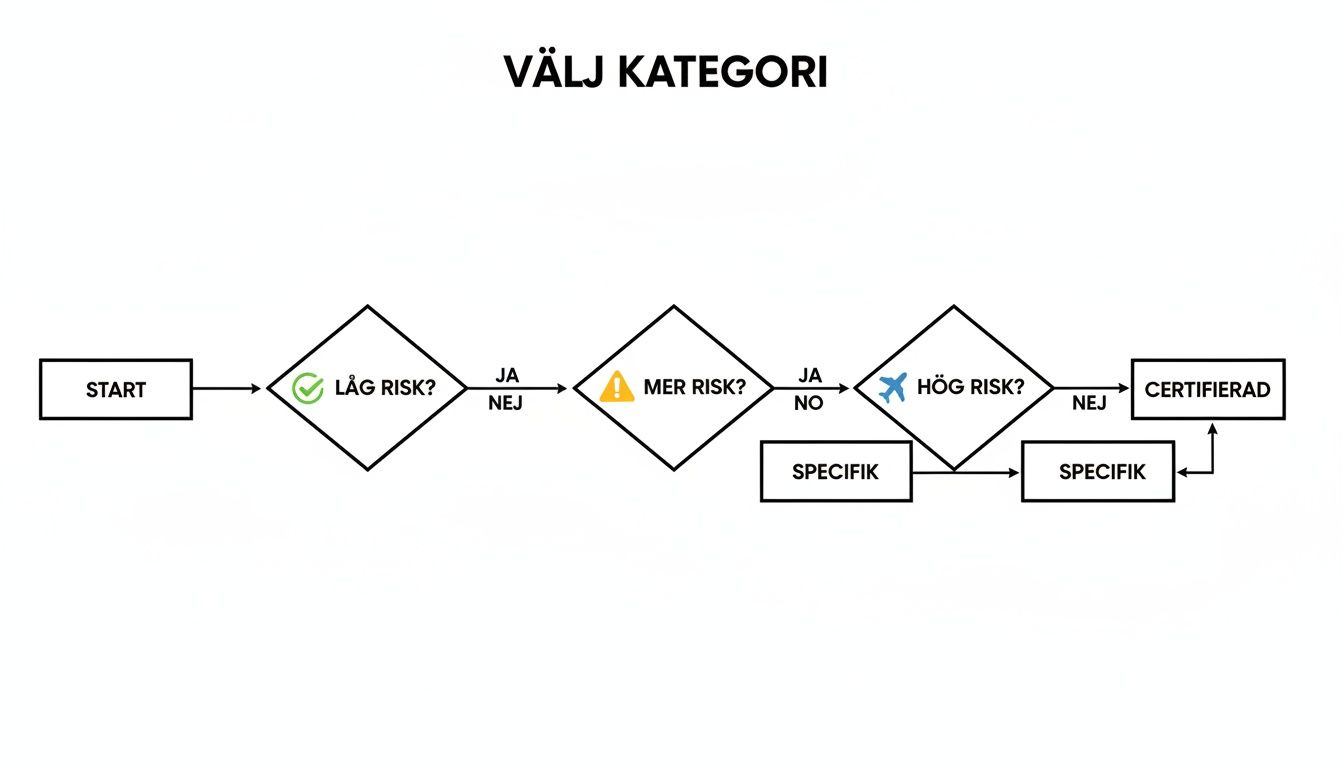
As you can see, almost all hobby flying is classified as low risk and falls into the Open category. However, more advanced missions require special permits.
After passing the test
As soon as you have passed the test, your remote pilot competency certificate (the drone license) becomes available for download in the Swedish Transport Agency's portal. Save it directly to your phone! You must always be able to present it if there's a check.
Think of the drone license as a driver's license for the air. It is proof that you have the theoretical knowledge required to fly safely and responsibly. It is simply your ticket to legal and fun drone flying.
Don't forget that the C-marking on your drone also affects which rules apply, even with the license in hand. And for those building their own drones from scratch, there are completely different things to consider. If you're curious about building your own, check out our guide on how to choose the right FPV drone kit in our guide.
The most important flight rules to know
Getting a drone license is just like getting a driver's license – it's really just the starting point. Now begins the real journey, where you must know the traffic rules in the air. Understanding and respecting these basic drone rules is essential for flying safely and avoiding unnecessary accidents, fines, or conflicts with others.
Think of the points below as your personal checklist before you even think about taking off.
The very first and most fundamental rule is that you must always keep the drone within your line of sight. In the drone world, this is called VLOS, which stands for Visual Line of Sight. It simply means that you must be able to see your drone with the naked eye at all times, without the aid of binoculars or screens, to assess its position and direction. Flying solely via the screen on your controller, behind a house, or through thick fog is therefore strictly forbidden.
Altitude and distance – your most important limits
Two numbers are extra important to remember. First, you must never fly higher than 120 meters above the ground or water. This altitude limit is not arbitrary; it exists to create a safety buffer for manned air traffic such as airplanes and helicopters, which sometimes fly at low altitudes, especially near airports.
Secondly: stay away from crowds. The law does not define a crowd with an exact number of people. Instead, it is about a group of people standing so closely together that they cannot easily move away if something goes wrong with the drone. Think festivals, sporting events, or a crowded market day – these are places where you absolutely must not fly over.
Keep track of flight zones with the Land Survey's drone map
The airspace is not a free playground. It is divided into different zones, and many areas have permanent or temporary flight restrictions. These are called geographic UAS zones. To know where you are and are not allowed to fly, the Land Survey's (Lantmäteriet) drone map is your most important tool.
The red areas on the map clearly show where it is forbidden to fly or where special permits are required. This often includes areas around airports, prisons, nuclear power plants, and sensitive nature conservation areas. Make it a habit to always check the map before you take off!
Respect privacy – GDPR also applies in the air
Last, but definitely not least: your drone has a camera. This means you are obliged to comply with the General Data Protection Regulation (GDPR) and show respect for people's privacy. Filming or photographing people in a way that they can be identified, without their express consent, can lead to serious consequences.
A good rule of thumb is to avoid filming places where people expect to be private – such as in their gardens, by their residential buildings, or at a swimming area. This is a complex area, and a common question concerns neighbors and their property. To truly understand what applies, you can read our detailed guide on flying drones over someone else's property. Knowing this protects both you and everyone around you.
What the drone's CE-marking actually means for you
Have you seen markings like C0, C1, or C2 on new drones and wondered what they mean? It's not just technical mumbo jumbo – it's the drone's CE classification, and it's your absolute best quick guide to which drone rules apply to that specific model.
The system of CE classes was developed to make it crystal clear what you can and cannot do. Each class is linked directly to the drone's weight and built-in safety features, which in turn determines everything from how close to people you can fly to which drone license you need in your pocket.
Understanding the most common C-classes
Think of the C-classes a bit like weight classes in boxing – they simply determine which arena you can compete in. A super-light drone in class C0, weighing under 250 grams, gives you immense freedom. You can fly near individual people (but never over crowds!) and you don't even need a formal drone license.
If you step up to a C1 drone, which can weigh up to 900 grams, the rules get a bit tougher. Then you must have an A1/A3 drone license. The rules are still quite generous, but you are expected to be more careful and actively avoid flying over people who are not involved.
The CE marking is your best friend when choosing a drone. It immediately gives you a sense of the limitations that come with it, so you can buy a model that actually fits both your ambitions and the places you want to fly.
Overview of CE marking classes (C0-C4)
To make it even simpler, we've put together a table showing the relationship between class, weight, and the basic rules you need to know.
| CE Class | Maximum Take-off Mass (MTOM) | Drone License Requirement | Basic Rule for Flying Near People |
|---|---|---|---|
| C0 | Under 250 g | No requirement (but read the manual!) | Can be flown near, but not over, individual persons. |
| C1 | Under 900 g | A1/A3 required | Avoid flying over uninvolved persons. |
| C2 | Under 4 kg | A2 required | Keep at least 30 meters horizontal distance. |
| C3/C4 | Under 25 kg | A1/A3 required | Fly at least 150 meters from residential, industrial, and recreational areas. |
As you can see, the requirements for distance and training quickly increase the heavier the drone is. That is the whole point of the system: more weight and potential for damage means more responsibility for you as a pilot.
But what happens to older drones without C-marking?
Don't worry, your old faithful is not unusable! Many people have drones that were bought before this system existed. These are called "legacy" drones, and they fly under specific transitional rules.
A drone under 250 grams without marking, like an older DJI Mini, follows basically the same rules as a C0 drone. If you're curious about how a cutting-edge C0 drone performs, you can check out our guide on the new DJI Mini 5 Pro. For heavier legacy drones, however, it is usually the strictest rules in subcategory A3 that apply, meaning you need to keep significant distances from buildings and people.
What happens if you break the rules?
Flying a drone comes with big responsibility, and ignoring current drone rules is not something the authorities take lightly. Whether it happens intentionally or by accident, a violation can lead to significant consequences – and we are talking about much more than a simple warning.
The penalty is designed to match the severity of the violation. A minor slip-up, like forgetting to mark the drone with your operator number, can end with a fine. But if you fly in a way that risks the safety of others, the consequences can be much tougher.
Flying within a restricted area, for example near an airport, is among the most serious things you can do. It is classified as aviation sabotage and can, in the worst case, lead to imprisonment for up to two years. The point is not to scare you, but to show how incredibly important it is to be aware of the situation.
Common mistakes that can cost you dearly
Many rule violations are due more to ignorance than to bad judgment. To help you avoid the most common traps, we have collected some typical scenarios that can easily lead to problems:
- Accidental flight in a control zone: You're out flying near a small town, completely unaware that you've just crossed the boundary into the airport's control zone. Whether it was intentional or not, this is a strict violation.
- Invasion of privacy: You film a beautiful sunset over a residential area, but happen to zoom in a bit too close to the neighbor's pool party and then post the clip on social media. This can lead to fines for violating GDPR.
- Flying over 120 meters: Of course, it's tempting to capture that magnificent view from a very high altitude, but passing the 120-meter limit is illegal. It creates an unnecessary risk for manned aviation flying higher up.
To ensure you can fly safely and legally every time, a simple checklist is worth its weight in gold. Use it to quickly and systematically check off the most important points before you even think about taking off.
Checklist before every flight
- Check the drone map: Have you double-checked that you are outside all restricted areas on the Land Survey's drone map?
- Check the weather: Is visibility good and is the wind suitable for your specific drone?
- Keep the drone within line of sight (VLOS): Do you have a clear plan for how to be able to see the drone throughout the entire flight?
- Check the surroundings: are there crowds, animals, or other obstacles nearby that you must take into account?
- Check the batteries: Are the batteries in both the drone and the controller fully charged so you have time to finish the flight and land safely?
Frequently asked questions about drone rules
The regulations can feel complex, and similar questions often arise from both new and experienced pilots. Here we have collected answers to some of the most common concerns to give you quick and clear help.
Do I need liability insurance for my drone?
Yes, in some cases it is an absolute requirement. If your drone weighs over 20 kg, you must by law have liability insurance that covers damage to third parties.
For most hobby drones that weigh less, it is not a legal requirement, but it is something we strongly recommend. An accident can happen quickly and can be a very expensive story if you happen to damage someone's car, window, or other property. Your regular home insurance rarely covers such things, so separate drone insurance is cheap peace of mind.
Is it allowed to fly drones when it's dark?
Sure, flying at night is allowed! But it places significantly higher demands on you as a pilot and on your equipment. To be allowed to fly in the dark, your drone must have a flashing green light.
This light should be clearly visible from both the ground and the air, so that others can detect your drone and avoid a collision. The purpose is simply to increase safety when visibility is poorer.
Keep in mind that your own ability to judge distances and keep the drone within line of sight (VLOS) is significantly impaired in the dark. Be extra careful, fly lower, and stick to open areas that you know well.
What applies to tourists who want to fly drones in Sweden?
The same rules apply to everyone, regardless of where you come from. If you visit Sweden as a tourist and want to fly your drone, you must follow exactly the same EU rules as we Swedes do.
This means you need to:
- Register as an operator in your home country (provided it is an EU country).
- Get a drone license (remote pilot competency certificate) corresponding to the drone class you will be flying.
- Mark your drone clearly with your operator number.
Your operator ID and your drone license from another EU country are fully valid throughout Sweden. It's smooth and easy to fly legally throughout the Union!
Need new propellers, filters, or extra batteries for your next flight? At ActionKing, you'll find the Nordic region's largest selection of accessories for your DJI drone. Explore the entire range at https://actionking.se.


