

A power bank is essentially a portable battery that charges your gadgets when you're far from a wall outlet. But for those of us who are truly out in the field, it's more than that – it's the lifeline that keeps the drone in the air and the camera rolling when it really matters.
Why your standard power bank isn't enough
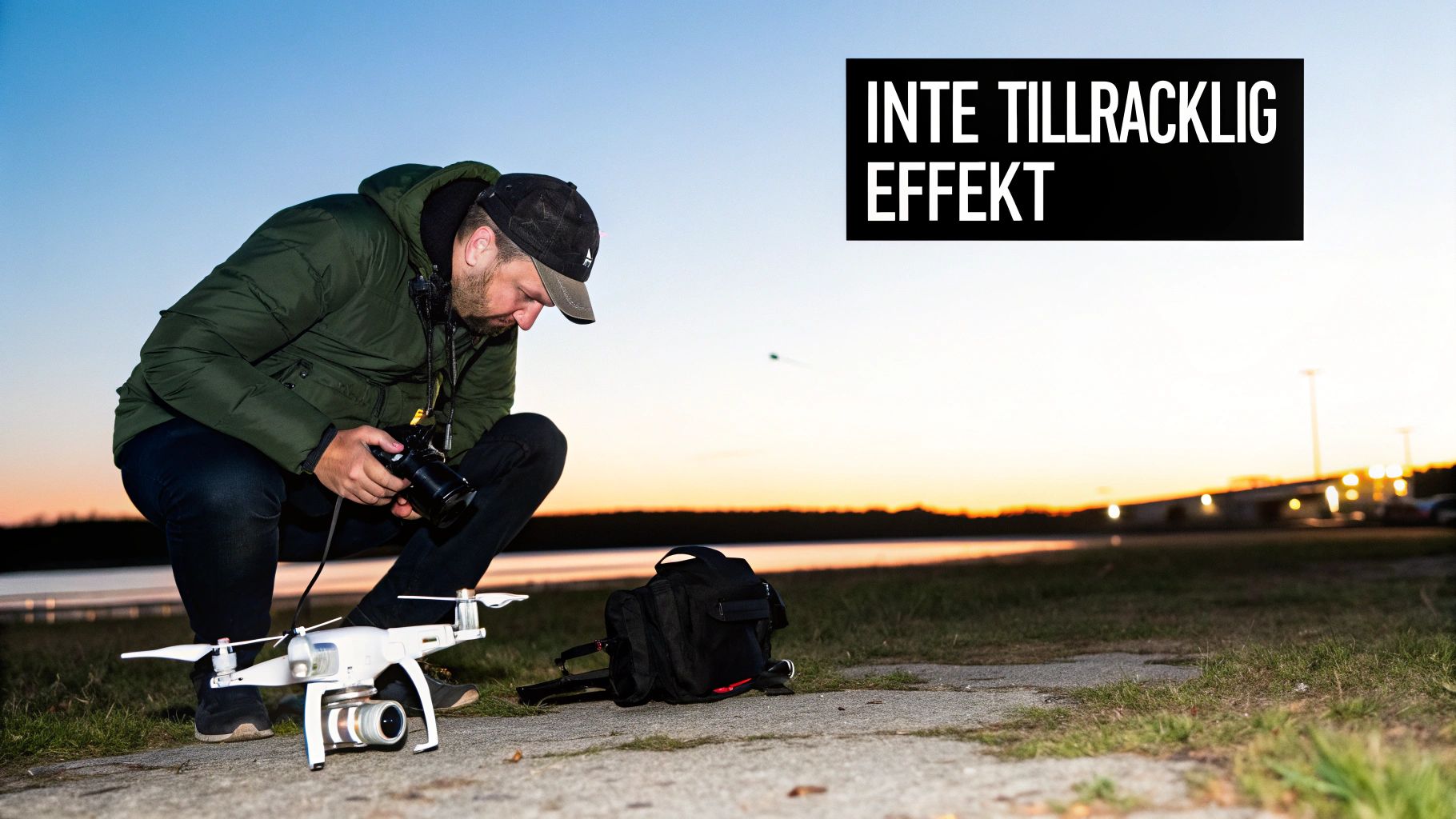
Imagine this: you've hiked for hours for that perfect sunset shot, the drone is ready to take off, but the battery is stone dead. You pull out your standard power bank, the one that works fine for your phone on the bus, but it can barely wake the drone battery to life. It's an incredibly frustrating feeling that too many of us have experienced.
The reason is actually quite simple. Equipment like drones and DSLR/mirrorless cameras have completely different power requirements than a smartphone. It's not just about more capacity, but primarily about a higher and more stable output power for charging to be efficient and safe.
Demands set by nature
When you're out in the wilderness, more challenges arise that a standard charger is rarely built for. Factors like sudden temperature drops, moisture, and inevitable bumps place entirely different demands on your equipment's durability and performance.
- Power needs: Drone batteries need high power (wattage) to charge quickly, something most pocket chargers simply lack.
- Stability: A cheap power bank can provide uneven current, which in the worst-case scenario can damage your expensive electronics. That's a risk you don't want to take.
- Robustness: Adventures require equipment that can withstand rough handling, moisture, and large temperature fluctuations.
Understanding these unique requirements is essential. It's not enough just to bring power – it must be the right kind of power that is both safe and reliable for your equipment.
Modern batteries are the result of advanced research, and here in Sweden, we actually have a strong tradition in battery technology that has paved the way for safer and more sustainable solutions. Specialized models like the Nitecore NB20000 are a perfect example – they are designed from the ground up for exactly these demanding conditions.
Okay, diving into technical specifications can feel like reading a manual from another planet, but this is where the gold is hidden. Understanding a few key figures is the difference between a power bank that saves the day and one that just becomes dead weight in your pack.
Let's start with the most obvious: capacity, measured in milliampere-hours (mAh). This figure is simply a measure of how much "fuel" the power bank holds. A number like 10,000 mAh might sound abstract, but think of it this way: a standard battery for a DJI Mini drone holds about 2,500 mAh. In theory, you could therefore charge the drone almost four times.
But, and this is important, some energy is always lost in the transfer. A good rule of thumb is that you practically get about 70–80% of the stated capacity. This gives a much more realistic picture of what you can expect in the field.
More than just size – speed is crucial
However, capacity is only half the story. Just as important, if not more so, is the output power, measured in watts (W). This number tells you how fast the power bank can deliver the energy.
A low output of 5W might work for slowly trickle-charging a phone, but trying to charge a large camera battery with that power is like trying to fill a pool with a straw. It will take forever, if it works at all.
Comparison of power bank types for different needs
To make the choice a bit easier, I've put together a quick overview. This table helps you quickly see which type of power bank fits best depending on what you're doing and what equipment you're bringing along.
| Need | Recommended Capacity (mAh) | Key Feature | Example Use |
|---|---|---|---|
| Day trip with phone & action camera | 10,000 - 15,000 mAh | At least 18W output | Keeping your phone and a GoPro alive during a full-day hike. |
| Weekend adventure with DSLR/Mirrorless | 20,000 mAh | High output (30W+) & USB-C PD | Charging a camera, phone, and perhaps a headlamp overnight. |
| Multi-day trip with drone | 20,000 - 27,000 mAh | Very high output (45W+) & multiple ports | Charging multiple drone batteries, camera, and other gear in the wilderness. |
| Light packing, max performance | 10,000 mAh | Very high output (65W+) & compact format | Fast-charging a laptop or drone on the go without carrying heavy weight. |
As you can see, it's about matching both capacity and power to your specific equipment. A powerful drone simply requires more "juice" to be charged effectively.
Future-proof your charging with USB-C PD
Finally, the ports. If you see a USB-C port labeled PD (Power Delivery) on a power bank, you've found something good. It's more than just a port; it's a smart technology that lets the power bank and your device "talk to each other" to deliver exactly the right amount of power, as quickly and safely as possible.
For modern equipment like drones, cameras, and laptops, USB-C with PD is no longer a luxury; it's often a requirement for charging to work at all. It's the new standard ensuring your investment works just as well with the gadgets you buy tomorrow. If you want to nerd out a bit more on why this is so important, you can read more about the combination of power banks and USB-C here.
Handling your power bank safely in nature
Being able to charge your gear in the middle of nowhere is a game-changer, but it comes with a certain responsibility. A power bank is essentially a small, compact battery pack. Like all other electronics, it requires a little common sense to handle safely, especially when you're far from the nearest outlet.
Safety actually starts when you buy it. Always choose a power bank that has built-in protections. These aren't just fancy words on the packaging – they are crucial for preventing overheating, short circuits, and overcharging. These are exactly the types of problems you absolutely don't want to encounter in a tent or with the power bank packed away in your backpack.
Trust the markings
It's easier than you might think to see if a product is safe. Look for a few clear signs of quality:
- CE Marking: This little symbol shows that the manufacturer guarantees the product complies with basic EU safety requirements. A good start.
- Clear Manufacturer Info: A serious player doesn't hide. You should easily see who manufactured or imported the product.
- Correct Voltage: If you charge your power bank at home with a wall adapter, make sure it is adapted for 230 V.
The Swedish Electrical Safety Authority stops many dangerous electrical products every year, often cheap gadgets from countries outside the EU. A scary example is the case of 11-year-old Benjamin, who received a serious electric shock from a poor-quality charger. This really shows how incredibly important it is to choose products from reliable sources.
This decision tree provides a quick visual overview to match the right power bank with your equipment, your capacity needs, and the ports you require.
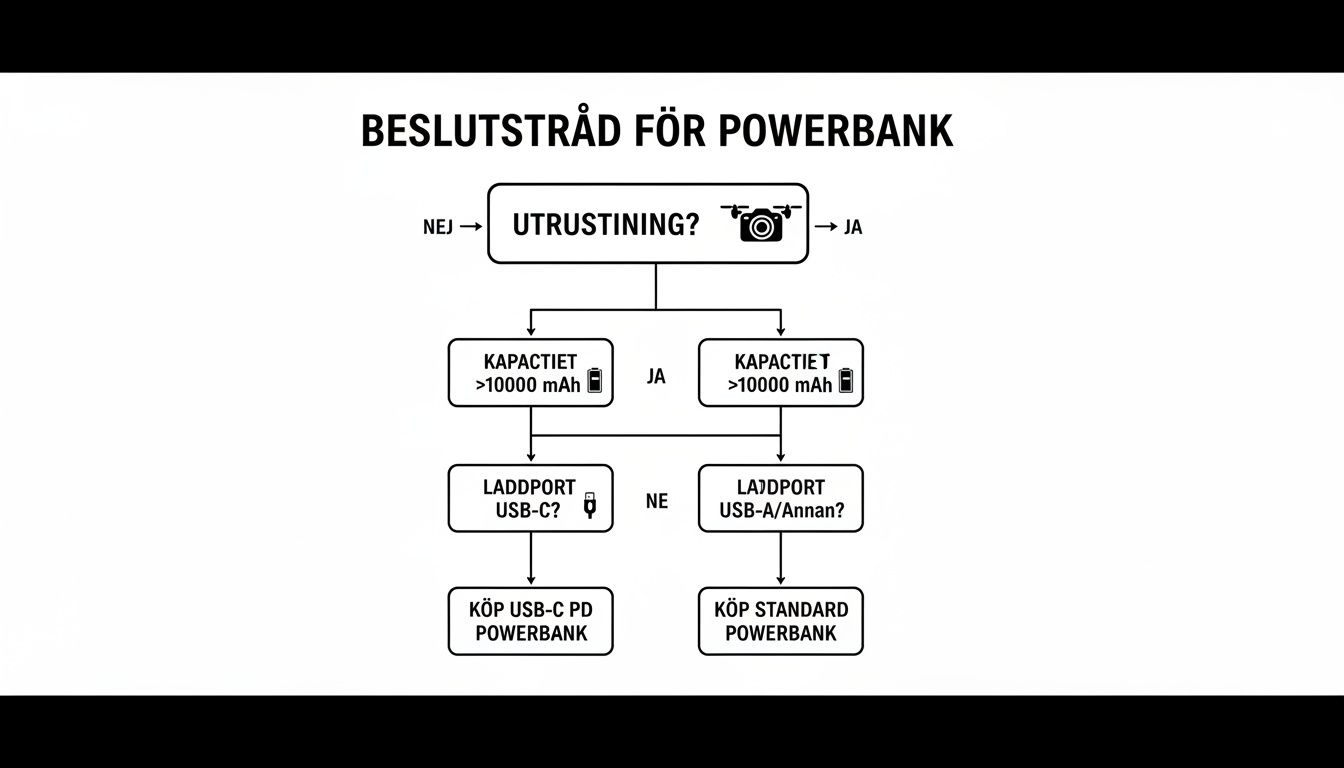
Follow the flow and you'll see immediately how your gadgets affect the type of power bank you should invest in. Simple and logical.
Protect your power bank against the elements
Once out on an adventure, it's your job to protect your power bank. Moisture, shocks, and extreme temperatures are lethal to lithium-ion batteries.
A simple, waterproof dry bag can be the cheapest insurance policy you ever take out for your electronics. Keeping your power bank dry is essential for both function and safety.
Avoid leaving it in a scorching hot tent in direct sunlight or in an ice-cold car overnight. Extreme temperatures can damage battery cells permanently and significantly reduce capacity. Handling your gear correctly is an important part of any survival gear kit. Take care of your power bank, and it will be there for you when you need it most.
Getting the most out of your charge on longer adventures
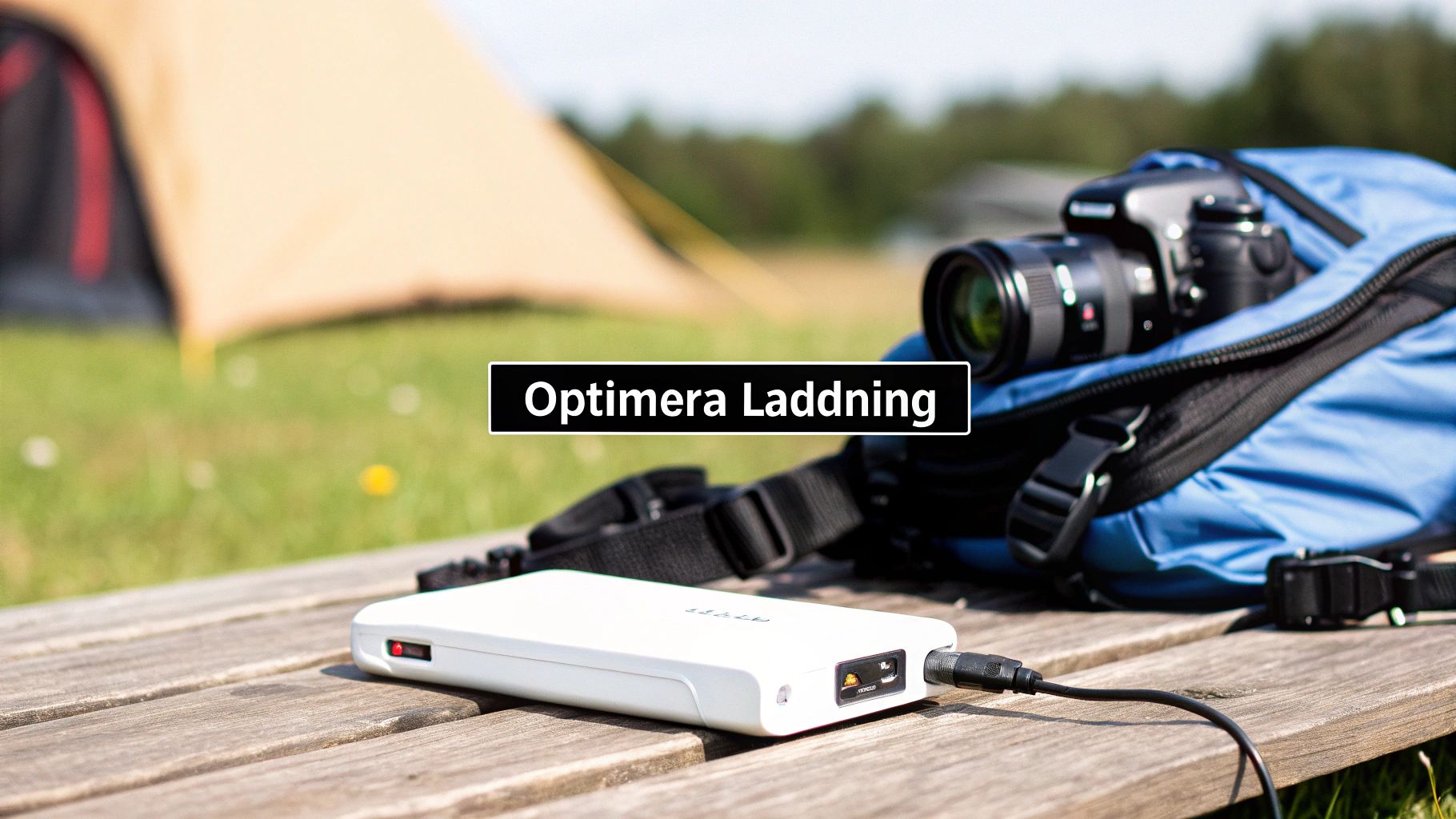
Packing a powerful power bank is a great start, but it's only half the job. To truly manage in the wilderness, you also need a smart charging strategy. It's about using energy the right way and avoiding unnecessary waste, especially when every percentage point is worth its weight in gold.
A feature often discussed is pass-through charging. This simply means you can charge your camera or drone from the power bank while the power bank itself is being charged from the wall. It's a real lifesaver when you find a single power outlet in a mountain cabin and need to charge everything overnight.
But the technology has a downside. It generates extra heat, which over time can wear down the battery cells in your power bank. My advice? Use the feature when you absolutely have to, but don't make it a habit if you want your equipment to last as long as possible.
Avoid the most common energy thieves
Energy can seep away in more ways than you'd think, and it's often the small details that make the big difference. With a little awareness, you can get significantly more juice out of your stored power.
- Use short cables: The longer the cable, the greater the energy loss. A short, high-quality USB-C cable is always more efficient than that long, worn-out cord that's been rattling around the bottom of your backpack.
- Protect against cold: Lithium-ion batteries lose measurable performance when the temperature drops. Keep your power bank in your sleeping bag or in an inner pocket close to your body during cold nights to keep it warm and ready for action.
- Watch out for extreme heat: Leaving a power bank in a sun-baked tent is not only inefficient – it's a direct safety risk. Keep it cool to preserve the battery's health and maximum capacity.
Planning your power supply is just as important as packing the right clothes. Think about how many charges you actually need and when. Wait to charge gadgets until necessary to minimize self-discharge.
For those really long trips where even the largest power bank isn't enough, the combination with a solar panel is a total game-changer. By letting the sun top up your power bank during the day, you can extend your adventures almost indefinitely. It gives you a fully self-sufficient energy system, right in the middle of nowhere.
Want to know more? Read our guide on portable solar panels to see how to choose the right model. By combining these strategies, you don't just use your power bank – you master it.
Choose a sustainable power bank with the Nordic Swan Ecolabel
When choosing a power bank, it's easy to get stuck on figures like capacity and charging time. But your choice has an impact that extends far beyond your own adventures. In a jungle of electronics, sustainability and safety are becoming increasingly important – and that's where ecolabels come into play.
One of the most important to look for is the Nordic Swan (Svanen), the official Nordic ecolabel. Choosing a Nordic Swan Ecolabelled power bank is not just a statement; it's a guarantee. It means the product has been strictly reviewed from a life cycle perspective, from manufacturing to recycling. It's about much more than just energy efficiency.
What the Nordic Swan Ecolabel actually guarantees
For a product to carry the Swan logo, it must pass a series of tough requirements that directly affect both the environment and your safety as a user.
- Strict chemical requirements: There are hard limits for heavy metals like mercury, cadmium, and lead in the battery.
- Ban on hazardous substances: Harmful chemicals like PVC and certain flame retardants are completely banned.
- Guaranteed performance: The labeling also ensures a high minimum level for the battery's capacity and lifespan. You simply get a product that delivers on its promises.
Choosing a Swan-labeled product is therefore not just an environmental choice. It's a quality stamp ensuring your power bank meets high standards for both safety and function, giving you peace of mind on your trip.
A real milestone came in 2023 when the world's first Nordic Swan Ecolabelled power bank was launched – right here in Sweden. This is especially important considering that the Swedish Electrical Safety Authority stops a large number of dangerous electrical products every year, often imported from outside the EU. Read more about how labeling strengthens safety at Swedac.
By actively looking for the Swan logo, you're not only making a smarter choice for the planet, but also a better investment in a safe and reliable product you can trust when it really matters.
Quick answers to common questions in the field
Even the most careful planning cannot foresee everything. Once you're out on an adventure, unexpected questions can arise. Here, I've gathered answers to some of the most common concerns, so you can feel completely secure the next time you pack your bag.
Can I bring my power bank on a flight?
Absolutely, but it must be in your carry-on luggage, never in your checked suitcase. Most airlines have set a limit of 100 Wh, which usually corresponds to around 27,000 mAh.
Do you have a really beefy model that exceeds the limit? Then you might need to seek special permission from the airline. My advice is to always double-check their rules before you leave. It takes two minutes and can save you a lot of headache at the security checkpoint.
How should I store my power bank when not in use?
Between adventures, your power bank feels best when resting in a cool, dry place, far from windows and direct sunlight. If it will be sitting for a long time, it's smartest to keep the charge around 50–60%.
Leaving it either fully charged or completely empty for long periods is a surefire way to wear out the battery cells prematurely and shorten its lifespan.
Think of it as letting it recover, not that it needs to be ready for takeoff 24/7. Proper storage is essential for a power bank that performs year after year.
Why does it take forever to charge my drone battery?
This is a classic issue, and I've experienced it myself. Usually, it's because your power bank has too low an output power – too few watts (W). Drone batteries are incredibly thirsty and require a substantial push of power to charge in a reasonable time.
Check that your power bank actually has a fast-charging technology like Power Delivery (PD). Equally important is that you use a high-quality cable built to handle high power – a cheap cord easily becomes a bottleneck.
Are you ready to find a reliable power source that can handle your adventures? At ActionKing, you'll find a carefully selected range of power banks and accessories made for tough conditions. Take a look at the selection and ensure you're never without power when the moment is at its best. Click here to see our power banks.


