

Forget that old image of a flashlight as a forgotten gadget rattling around in a junk drawer. Today's models are high-tech tools, where a powerful LED flashlight can be just as essential on a late-night dog walk as it is during a demanding mountain hike.
This guide isn't just about finding a flashlight; it's about finding the right flashlight for you and your specific needs.
More than just a light source in the dark
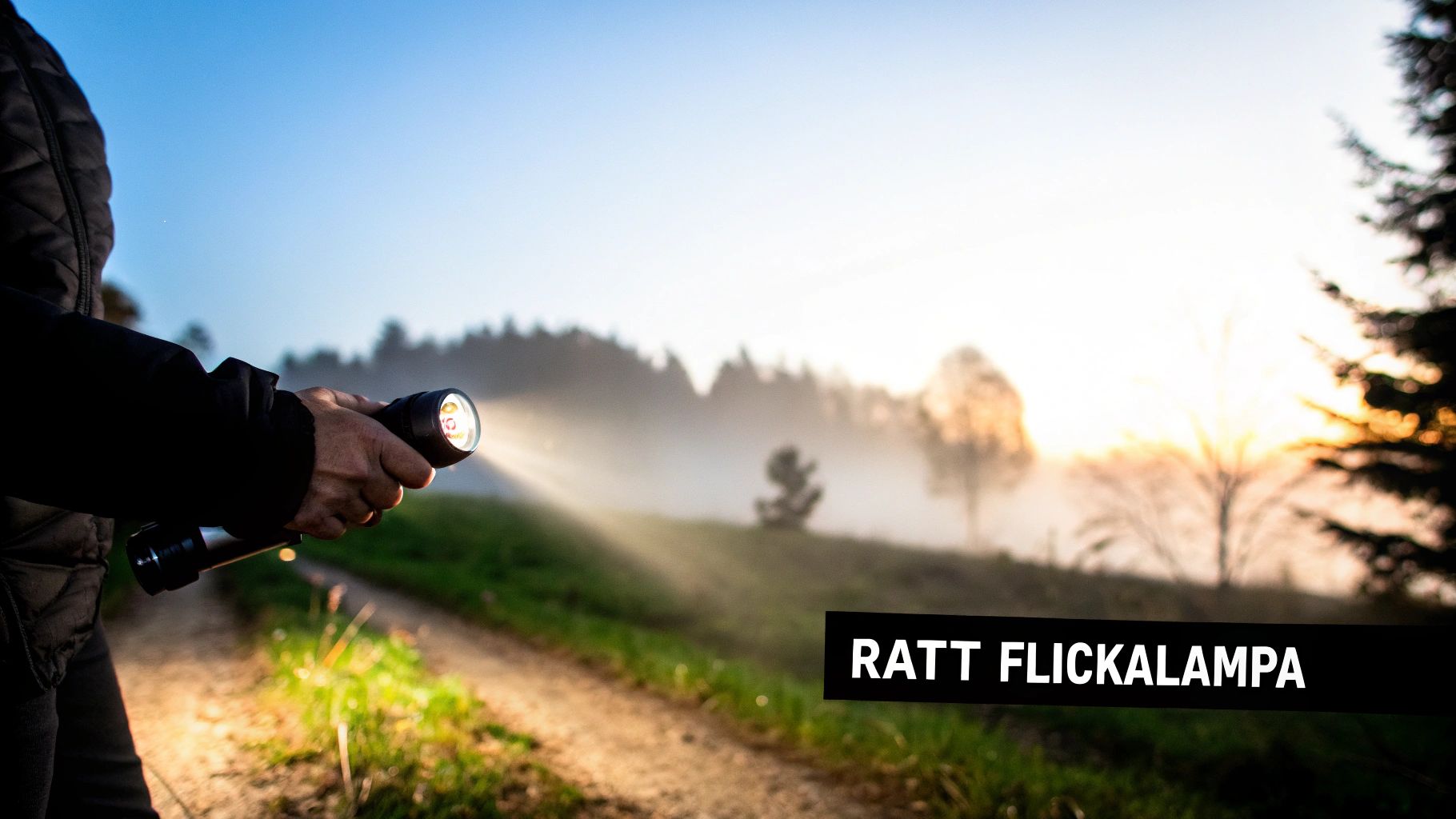
Technological developments, especially in LEDs, have totally transformed what we can expect from portable light. Just a few decades ago, flashlights were often clunky devices with a weak, yellowish glow and batteries that seemed to die the moment you looked at them.
Today, the landscape is entirely different. A modern flashlight is a precision instrument capable of pumping out thousands of lumens in a format that easily fits in the palm of your hand.
The situation dictates your choice
What you intend to use the flashlight for is the absolute most important question to ask. Requirements differ enormously between scenarios, and no single model is best at everything.
- Everyday Use: For finding items in the back of the basement storage or for peace of mind during a short power outage, a small, compact flashlight with moderate brightness works perfectly.
- Outdoor Life: When camping or hiking, you need a robust and water-resistant model with long battery life. A red light mode to preserve night vision is also a very smart feature.
- Emergency Situations: For emergency preparedness or as part of your survival gear in the car, you want something else entirely. Here, extremely high brightness, an SOS mode, and impact-resistant construction are key.
Investing in the right flashlight is about enhancing your safety and experience. Don't see it as a cost, but as insurance against the dark—whether you're looking for dropped keys or navigating an unfamiliar trail at night.
Choosing the right flashlight is quite simply a cornerstone of building a reliable kit for various situations. The goal of this article is to give you the knowledge to make a smart and informed choice. We will cover everything from brightness and battery types to materials and smart features, so you can find a flashlight you can rely on in any situation.
Lumens and Beam Pattern – More Than Just Numbers
When checking out flashlights, it's easy to get stuck on one figure: lumens (lm). Manufacturers love to advertise it, and sure, it's a measure of the total amount of light the lamp emits. But blindly staring at a high lumen count is like buying a car based only on horsepower—it doesn't tell the whole story.
The reality is a bit more complex. Think of lumens like the water in a garden hose. You can either spread it across the entire lawn (a wide beam, or "flood") or concentrate it all into a powerful stream to reach the far end of the garden (a focused beam, or "spot"). The amount of water is the same, but the result is completely different. A flashlight works exactly the same way.
Raw Power Isn't Always Right
A flashlight with a sky-high lumen count isn't automatically the best. Sometimes, too much light can actually be a bad thing. Try reading a map in a pitch-black tent with a 2,000-lumen light and you'll understand what I mean—you'll be totally blinded and your night vision will be shot for a long time. In that case, a small 100-lumen light with a soft, wide beam would have been infinitely better.
The same applies to fog or snowfall. Light that is too strong simply bounces back, creating a white wall in front of you that makes it harder to see. Then there's battery life. Maxing out a flashlight draws an extreme amount of power, and runtime can drop from several hours to just a few minutes.
The balance between lumens and the shape of the beam is crucial. Consider what you are actually going to do with the light, rather than just who has the strongest lamp on paper.
So, How Much Brightness Do You Need?
To make it a bit easier, I've put together a quick guide. These figures are, of course, approximate, but they provide a good indication of what to look for in different situations.
Recommended Brightness for Various Activities
A quick guide showing which lumen level is best suited for common uses, from everyday chores to demanding outdoor activities.
| Activity | Recommended Lumens (lm) | Beam Type |
|---|---|---|
| Everyday Use (home, dog walks) | 50 - 300 | Wide (Flood) |
| Camping & General Outdoors | 300 - 1,000 | Combined |
| Hiking in Forest & Terrain | 500 - 2,000 | Combined/Spot |
| Cycling (Commuting/Trail) | 800 - 2,500+ | Wide with some reach |
| Search & Rescue / Spotting | 2,000 - 10,000+ | Focused (Spot/Throw) |
| Tactical Use / Security | 1,500 - 5,000 | Focused with wide spill |
As you can see, you rarely need the very highest numbers. Most people get along fine with a light under 2,000 lumens, as long as the beam pattern is right for the task.
The Shape of the Beam is Decisive
It is the flashlight's reflector and lens that shape the light, and this is at least as important as the number of lumens. The shape determines how the light hits the target and what the lamp is actually good at.
- Wide Beam (Flood): Perfect for illuminating a large area at close range. It's superb for camping, working on a car, or needing to see what's right at your feet. The light is even and pleasant without a blinding center point.
- Focused Beam (Spot/Throw): Built for one thing: distance. It throws a concentrated beam of light extremely far and is unbeatable for search tasks, navigating open terrain, or if you need to inspect something hundreds of meters away.
- Combined Beam: This is the most common and versatile type. You get a strong point in the center for reach, while a softer, wider light illuminates the surroundings. A great all-round solution.
Some models also feature adjustable focus (zoom) which allows you to switch between wide and focused light. This provides flexibility but can sometimes come at the cost of water resistance and optical performance.
For those who truly need extreme performance for demanding tasks, there are, of course, specialized lights like the Nitecore TM20K with an incredible 20,000 lumens, which delivers both enormous width and range simultaneously.
Choosing the Right Power Source – The Heart of the Flashlight
A truly great flashlight is entirely dependent on its power source. The battery is the heart that pumps life into the lamp, and your choice affects everything from how bright it shines to how long it can keep going. It's a detail that's easy to forget but deserves as much thought as the lamp itself.
There are basically three paths to take when it comes to batteries, and the choice depends entirely on how you plan to use your flashlight.
The Three Most Common Battery Types
Understanding the differences is key to finding a solution that fits your needs.
- Rechargeable (e.g., 18650, 21700): This is the standard in most modern and powerful flashlights. They have high capacity and can deliver the current required to drive high-performance LED chips. While the initial cost is higher, they quickly become cheaper in the long run compared to constantly buying new disposable batteries.
- Classic AA/AAA: The main advantage here is availability. You can find them in every grocery store and kiosk, no matter where in the world you are. Perfect for a lamp kept for home emergencies or in the car. However, they don't have the same punch as specialized lithium-ion batteries. If you use lamps with these batteries often, a smart investment is to get rechargeable AAA batteries or AA versions. You'll save money and protect the environment.
- Built-in USB-rechargeable batteries: Increasingly common in smaller, convenient flashlights. The convenience is unbeatable—you can charge them directly from a power bank, computer, or wall adapter without bringing a separate charger. The downside? When the battery is empty, you can't just swap it for a new one; the whole lamp needs to be recharged.
Pro tip: Find out how your flashlight regulates its light. Some models shine at constant brightness until the battery dies abruptly. Others gradually get dimmer. For safety during a long trip in the woods, the latter version is often better, as it gives you a clear warning that it's time to charge or change the battery.
This image provides a good overview of which brightness level is suitable for different situations, which in turn affects how long the battery lasts.
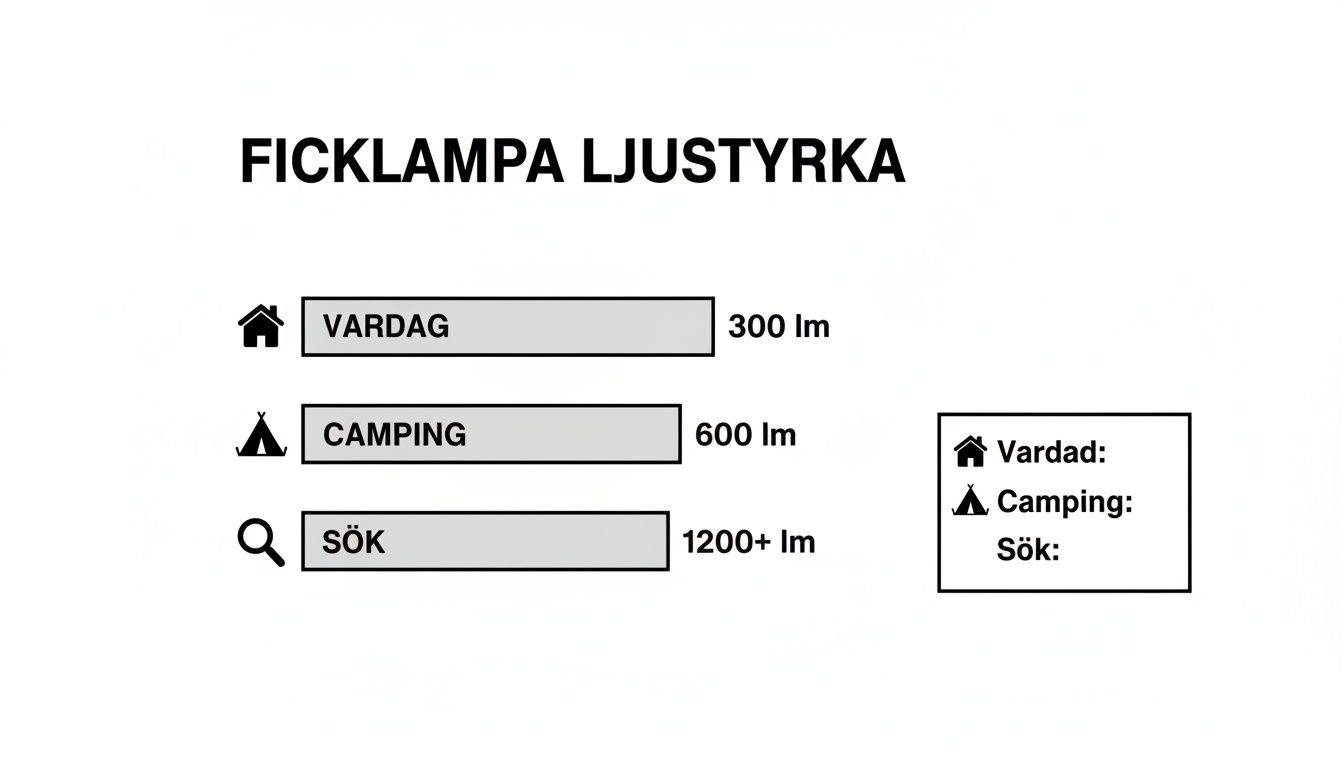
As the chart shows, more demanding activities require higher brightness, which draws significantly more power from the battery.
Maximize Battery Life and Recycle Correctly
Regardless of which lamp or battery type you have, you can extend the runtime yourself by being smart with the light. Simply don't use a stronger setting than you need. Modern LED chips and smart battery technology work together to provide impressive runtimes that were mere fantasy just a few years ago, but in the end, you as the user have the greatest impact.
When your flashlight or batteries have finally reached the end of their life, it is extremely important that they are recycled correctly. A flashlight contains both electronics and batteries and is classified as electronic waste. Correct recycling is not just good for the environment; it is crucial for recovering valuable materials. According to El-Kretsen, a total of 140,999 tons of electrical waste and batteries were collected in Sweden in a single year. By handing in your old flashlight and batteries at a recycling center, you ensure the cycle remains closed.
Build Quality and Materials That Last
A flashlight's brightness is important, but it's useless if the lamp goes out for good after the first bump or drowns in a summer rain. It's the build quality that determines if you have a reliable companion in the dark or just a gadget that fails when you need it most.
Material choice affects not only how durable your flashlight is but also how it feels to handle. Two materials dominate the market: aircraft-grade aluminum and various types of polymers. Both have clear advantages.
Aluminum vs. Polymer
Aircraft-grade aluminum (often called T6 aluminum) is the king of flashlight materials, and for good reason. It provides an unbeatable mix of low weight and serious strength, making the lamp tough enough for both everyday wear and unexpected knocks. Another major advantage is that aluminum dissipates heat away from the LED chip, which is crucial for the lamp to perform at its peak and last a long time.
Polymer, essentially impact-resistant plastic, is the other common alternative. Perhaps its biggest plus is that the material doesn't become biting cold to hold in winter—a comfort factor not to be underestimated. Polymer lights often resist scratches better and tend to absorb shocks without getting ugly dents like metal. They are often lighter and sometimes friendlier to the wallet.
Regardless of the material you choose, look for a lamp with an anodized finish (for aluminum) and a texture that provides a good grip. Hard anodizing protects against scratches and corrosion, and a secure grip reduces the risk of you dropping the lamp in the first place.
Understanding IP Ratings for Water Resistance
One of the absolute most important details for a flashlight's durability is its IP rating. This is an international standard that simply explains how well the lamp is protected against dust and, above all, water. When we talk about water resistance, it's the last digit (or the only digit after "IPX") that counts.
Knowing what the different levels actually mean helps you choose a lamp that can handle your specific adventures.
Here is a quick guide to understanding what the most common IPX ratings mean in reality.
| IPX Rating | Protection Level | Practical Example |
|---|---|---|
| IPX4 | Splash-proof | Can handle rain and water splashes from all directions. Perfect for dog walks and camping. |
| IPX6 | Water-resistant against jets | Withstands powerful water jets. You can rinse it off if it gets muddy after a trip. |
| IPX7 | Waterproof (temporary immersion) | Can withstand immersion up to 1 meter deep for 30 minutes. Dropped it in a stream? No problem. |
| IPX8 | Waterproof (continuous immersion) | Made to be underwater, often down to 2 meters or more. A must for boating and extremely wet environments. |
A lamp with at least IPX4 is a good starting point for most. But if you know you'll be out in heavy rain, near water, or in truly demanding environments, it's wise to go for IPX7 or IPX8. Then you can trust that your flashlight will work, no matter what the weather throws at you.
Useful Features and Smart Accessories
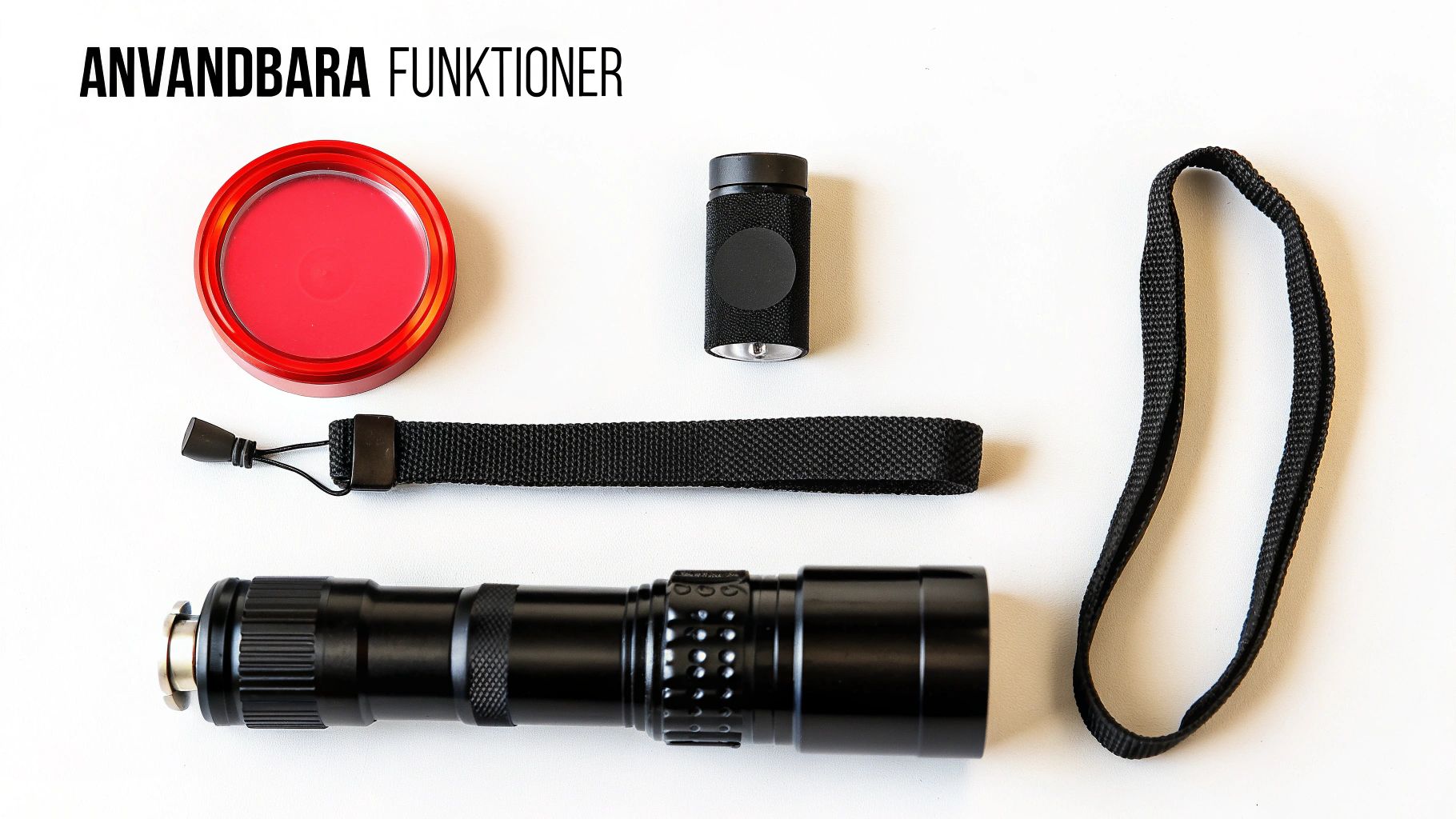
A modern flashlight is rarely just a lamp. Manufacturers pack them full of different functions and modes, but the question is: which are actually useful and which are just unnecessary gimmicks that drive up the price? The truth is that the right features can transform your flashlight from a simple light source into a versatile tool for all kinds of situations.
The most basic, and undoubtedly most important, is being able to switch between different light modes. Having a low mode to save battery inside the tent, a medium mode for general use around camp, and a max mode to light up the path far ahead is incredibly practical. This is the foundation of a good flashlight.
Features That Make a Real Difference
In addition to standard light levels, there are some special modes that can be invaluable in the right situation. It's all about understanding when they actually add value.
- Strobe: A lightning-fast, flashing light at maximum intensity. Highly useful for attracting attention in an emergency, or even for self-defense as it is extremely disorienting.
- SOS: The Morse code for distress (...---...). A feature you hope you never have to use, but which can be a lifesaver if you get lost and need to signal for help.
- Adjustable Focus (Zoom): Allows you to switch between a wide, flooding beam and a super-concentrated beam that reaches far. Very flexible, but a word of warning—cheaper zoom functions can be a weak point and compromise water resistance.
The key is not to be blinded by a long list of specifications. Instead, think about what problems you actually need to solve. Simplicity is often better than a complicated lamp with an interface that's hard to manage when it's dark and stressful.
Another feature that is becoming increasingly common, and which I personally find invaluable, is a built-in battery indicator. Clearly seeing how much power remains is a simple but immensely important detail. It's the difference between being prepared and suddenly standing there in the dark.
Accessories That Expand Use
Just as important as the lamp's built-in features are the accessories. With the right equipment, you can adapt your flashlight for entirely new tasks and make it much more useful.
A simple accessory can totally change how you use your flashlight. A red filter, for example, is a must for those who enjoy night navigation, hunting, or astronomy, as it preserves your natural night vision. The light doesn't affect your pupils in the same way, meaning you see the stars or your surroundings much better immediately after turning the light off.
A diffuser is another smart accessory. It's a small cap you attach to the lamp head that spreads the light evenly and softly. Suddenly, you've turned your flashlight into a perfect tent lantern or a pleasant work light. For cyclists, there are specific solutions, like a mount to use the flashlight on the bike. This is a brilliant way to get powerful lighting on your handlebars without having to buy a separate, and often more expensive, bike light.
How the Flashlight Became a Staple in Swedish Homes
The flashlight's journey from a technical novelty to an indispensable tool in every Swedish home is a story spanning over a hundred years of development. When the first models appeared in the early 1900s, they were clunky, expensive, and had batteries you could barely trust. They were more of a fun novelty than a practical aid.
The real turning point came as technology matured. Batteries became better, bulbs more efficient, and the overall construction more durable. The flashlight transitioned from a luxury item to a reliable tool for everyone from craftsmen to scouts, and later a natural part of the home emergency kit.
From Novelty to Status Symbol
A clear sign of its early adoption is that the Swedish word "ficklampa" (pocket lamp) actually began to be used as early as 1906. Many decades later, during the 1980s, certain models became almost iconic. Think of the small, robust Mini Maglite—it became a true status symbol and has sold over half a million units in Sweden alone. That says something about how a flashlight became a tool for everyone. Read more about the historical development of flashlights in Sweden.
This historical journey provides a deeper appreciation for the compact and powerful technology we often take for granted today. Every time you turn on your modern LED lamp, it is the result of over a century of development—from a weak flicker to a brutal beam of light.
Today, the flashlight has a permanent place in our daily lives, culture, and safety. it's there when the power goes out, when we're searching for something in storage, or when we need to light up the path on a late evening walk.
Frequently Asked Questions When Choosing a Flashlight
When it's time to get a new flashlight, similar questions often arise. To make your choice easier, we've gathered the most common questions and provide straight, clear answers.
How many lumens are actually needed for home use?
For most tasks in and around the house, such as rummaging in the basement storage or dealing with a sudden power outage, 100–300 lumens is perfectly sufficient. In fact, a lower brightness is often better as the batteries last longer and you avoid blinding yourself in dark, cramped spaces.
While a super-strong flashlight might seem tempting, in practice, a softer and wider light is almost always more useful indoors. You simply don't need max power for common everyday chores.
Is a rechargeable battery worth the money?
Yes, for most people, it's a solid investment in the long run. Even if a flashlight with a rechargeable battery costs a bit more upfront, you quickly save the money you would otherwise have spent on new disposable batteries.
Another major advantage is that you get significantly better and more consistent performance. Modern LED chips require quite a bit of juice, and rechargeable lithium-ion batteries can deliver that in a completely different way. Plus, it's a much smarter choice for the environment.
What does IPX8 mean and do I need it?
IPX8 is one of the highest ratings for water resistance you can find. It guarantees that your flashlight can withstand being fully submerged in water for an extended period, often down to two meters deep, without taking damage.
But do you need it? It depends entirely on how you plan to use the lamp.
- Yes, absolutely if you: Are often out on a boat, fish, or don't let a downpour stop you.
- Probably not if you: Mainly use it at home or for casual outdoor activities. In those cases, an IPX4 rating (splash-proof) is more than enough.
At ActionKing, you will find a carefully selected range of high-quality flashlights and accessories for every conceivable situation. Whether it's for everyday use or demanding adventures, we have something for you. Explore our range of Nitecore lighting and find your perfect light companion today. Visit ActionKing here.


