

Choosing the right power bank today is about so much more than just staring at battery capacity. It's about investing in technology that will stand the test of time. A modern USB-C power bank isn't just a smart choice – it's the new standard that provides higher speeds, smoother operation, and a versatility that older models could only dream of.
Why USB-C is the obvious new standard for power banks
Switching from the good old USB-A connector to USB-C is like leaving a one-way dirt road for a modern, multi-lane highway. The older standard could only send power in one direction and at a fairly limited speed. USB-C, on the other hand, can handle significantly more traffic – meaning higher output – and can also send it both ways.
This means the exact same USB-C port you use to charge your phone can also charge the power bank itself. Simple, right? This flexibility eliminates the need for a messy tangle of different cables and ports, significantly simplifying your tech life.
The smart technology behind fast charging
One of the main reasons a USB-C power bank is superior is its support for a smart technology called Power Delivery (PD). Think of PD as an intelligent negotiator between your power bank and the device you want to charge.
When you plug in your smartphone, laptop, or drone, the two devices start "talking" to each other to agree on the absolute best charging speed. The power bank essentially asks: "How much power can you handle safely and quickly?", and your device answers. The result? Your device charges as fast as possible, without any risk of overheating or damage.
USB-C with Power Delivery isn't just faster; it's smarter. The technology ensures that every gadget gets exactly the power it needs – ranging from just a few watts for a pair of headphones to over 100W for a powerful laptop.
Benefits that simplify your everyday life
This technological evolution offers concrete benefits that you will notice immediately:
- One cable for everything: Charge your phone, headphones, tablet, and even your laptop with the same cable and port. To truly maximize power, however, it's important to use the right kind of cable; a high-quality 240W USB-C to USB-C cable is a brilliant investment.
- Reversible connector: Finally, the frustration of trying to plug the connector in the right way is over. USB-C is completely symmetrical and fits no matter which way you turn it.
- Future-proof investment: More and more manufacturers, including giants like Apple, have moved to USB-C as the standard. If you choose a power bank with this technology today, you can be sure it will work with your gadgets for many years to come.
Understanding the power of your power bank – mAh and Watts explained
When looking at a USB-C power bank, you often see two numbers: milliampere-hours (mAh) and Watts (W). Understanding what they mean is essential to finding the right model for you.
Think of your power bank as a water tank. mAh is simply the size of the tank – it tells you how much total energy it can hold.
Watts (W), on the other hand, is how wide the tap is. A wide tap lets out a lot of water in a short time, while a narrow tap only gives a thin stream. Similarly, Watts determines how fast energy can flow from your power bank to your device.
A power bank with sky-high mAh but low Wattage is like a giant water tank with a straw for a tap. It holds a lot, but it will take forever to charge your phone. To get a good experience, capacity and speed must play on the same team.
This illustration clearly shows the two core functions of USB-C technology that make modern power banks so smart and efficient.
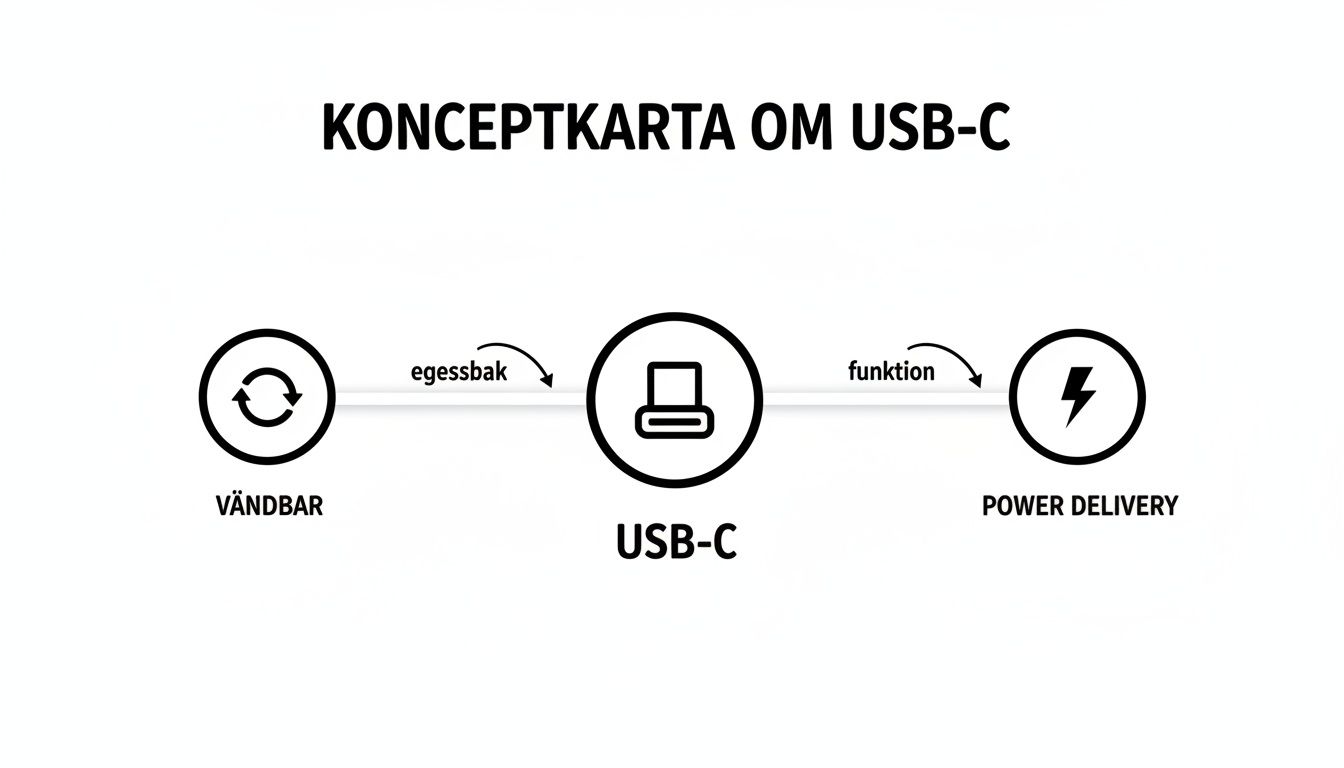
The image shows how the reversible connector and smart power management (Power Delivery) work together to provide a seamless and powerful charging experience.
How to calculate the number of charges
A common question is naturally: "How many times can I charge my phone with this?". The formula is quite simple, but there's one important thing to keep in mind – energy loss. No energy transfer is 100% efficient; some is always lost as heat along the way.
A good rule of thumb is to expect an efficiency of about 60–70%. This means a 20,000 mAh power bank effectively gives you around 12,000–14,000 mAh to actually use.
Let's take a concrete example with a 20,000 mAh power bank:
- iPhone 15 (approx. 3,350 mAh): 12,000 mAh / 3,350 mAh ≈ 3.5 charges
- DJI Mini 4 Pro battery (approx. 2,590 mAh): 12,000 mAh / 2,590 mAh ≈ 4.6 charges
- 11" iPad Pro (approx. 7,500 mAh): 12,000 mAh / 7,500 mAh ≈ 1.6 charges
This provides a much more realistic picture of what to expect in the field. The need for portable power has created a strong market, where power banks between 5,001 and 10,000 mAh are most popular thanks to their great balance of size and power.
Charging speed comparison with different wattages
The Wattage figure affects charging time dramatically, especially for modern devices that support fast charging. The table below shows how long it takes to charge a standard smartphone (approx. 4500 mAh) to 50% with different power outputs.
| Output (Watts) | Charging Technology | Approx. time to 50% charge | Suitable for |
|---|---|---|---|
| 5W | Old USB-A | > 1.5 hours | Trickle charging, older gadgets |
| 18-20W | Power Delivery (PD) | approx. 30 minutes | Modern smartphones, tablets |
| 45W | Power Delivery (PD) | < 25 minutes | Fast charging, smaller laptops |
| 65-100W | Power Delivery (PD) | < 20 minutes | Demanding laptops, multiple devices |
As you can see, a higher Wattage makes a huge difference. Moving from an old 5W charger to a modern power bank with 20W or more can halve your waiting time.
Wattage determines speed for demanding devices
While mAh determines endurance, Wattage is crucial when charging larger items like a laptop. A modern laptop often requires 45W, 65W, or even 100W to charge at a reasonable pace.
Trying to charge a laptop with a weak power bank is like trying to fill a pool with a straw – it simply won't work.
If you plan to charge more than just your phone or action camera, it's vital to choose a model with high power output. A powerful 100W power bank is a perfect choice for those who need to charge everything from camera batteries to laptops while on the go.
Choosing the right power bank for your needs
A power bank is not a one-size-fits-all gadget. The model that's perfect for a hiker is rarely the best for a city commuter. To find the right USB-C power bank, you simply have to start with yourself – your habits, your equipment, and your adventures.
Understanding how you will actually use it is the most important part. Instead of just looking at the highest mAh number, consider what's most important to you. Is it minimal weight, lightning-fast charging, or being able to charge everything you own at once?
Let's look at three common scenarios to help you find the right fit.
For the hiker and adventurer
When you're out on the trail, every gram counts. Here, a super-light and compact design is crucial. You want enough power to keep your phone and GPS alive for a weekend, without your pack turning into a brick.
A capacity of 10,000 to 20,000 mAh is often the golden middle ground. It gives you enough juice for several smartphone charges while remaining small enough to slide into a pocket. Look for models with a rugged shell that can handle a few bumps and maybe even dust or water resistance.
Will you be out longer, completely disconnected from the grid? Then a power bank with a small solar panel can be a smart addition. It won't charge fast, but it can trickle charge your power bank during daylight hours and provide that extra peace of mind.
For the photographer and drone pilot
For those creating content on the move, the requirements are completely different. Here, it's all about raw power and flexibility. Being able to charge multiple camera batteries, a drone, and perhaps even a laptop simultaneously is often a must.
Focus on two things: high output (Watts) and plenty of ports. A USB-C power bank with at least 65W output via Power Delivery (PD) is an absolute minimum for powering a modern laptop and fast-charging multiple gadgets at once. Look for models with multiple USB-C ports so you don't have to queue for charging. Capacity should also be substantial, preferably 20,000 mAh or more, to handle all that energy-demanding gear.
For the commuter and city user
If your power bank is mostly for topping up your phone on the way to work or during a long day in town, then portability is key. You don't need the largest capacity, but you want something that easily slips into a jacket pocket or handbag without being in the way.
A slim model of around 5,000 to 10,000 mAh is perfect. It's plenty for one to two full charges of your mobile, which is usually all that's needed to get through the day. A built-in cable can be a great bonus that eliminates clutter and ensures you're always ready.
To get a deeper look at the top models on the market, you can read our guide on the best power banks right now, where we compare options for all types of users.
What to expect from the market
Trying to navigate the jungle of USB-C power banks can feel a bit overwhelming, but there's actually a fairly clear logic to the selection. The days when advanced features like USB-C Power Delivery (PD) were only found in expensive premium models are over. Today, the technology has become much more accessible to everyone.
Our digital lifestyle, where we need to be constantly connected, has really driven development. Looking at what people buy, it's clear that many settle in the 10,000 to 20,000 mAh capacity class. That size is a perfect compromise between being easy to carry and having enough power to charge a standard mobile several times over.
Budget options under 500 SEK
In the lower price segment, you can find surprisingly capable gadgets. For under 500 SEK, it's no problem to find a 20,000 mAh power bank that supports fast charging via USB-C. These models are perfect for everyday use, commuting, and shorter trips when you just need to top up your phone or headphones.
So what's the catch? Usually, the compromise boils down to three things:
- Build quality: Materials are generally basic, often plastic instead of metal.
- Number of ports: You might get one USB-C port and one or two older USB-A ports.
- Maximum output: Power often stays around 20-30W, which is great for phones but not enough to charge a laptop.
The premium segment for demanding users
Stepping up in price opens up a whole new world of performance. Here we find the monster units built for the toughest situations, from powering an entire mobile workstation to handling week-long adventures without power access.
In the premium segment, it's not uncommon to find a USB-C power bank with a capacity over 40,000 mAh and an output of 65W, 100W, or even more. This is enough to fast-charge even the most demanding laptops from manufacturers like Apple and Dell.
These models often have multiple USB-C ports so you can charge your computer, mobile, and camera at the same time. They are built with premium materials like aluminum for better durability and heat dissipation. For those who want to be completely independent of the grid, these powerhouses are a perfect complement to portable solar panels for charging in the field.
The choice between budget and premium eventually comes down to your own needs. If you just need a reliable charger for your mobile, a budget option goes a long way. But if you're a creator, drone pilot, or often work on the go, the extra investment in a premium model with high power and capacity is well worth the money.
How to maximize the lifespan of your power bank
A USB-C power bank is a faithful companion on adventures, but like any other gear, it needs a little care to perform at its peak and last a long time. Taking care of it isn't just about extending its life; it's also about safety for you and your gadgets.
A modern power bank is more than just a battery; it's a small computer with built-in protection circuits. these are vital for preventing issues like overcharging, short-circuiting, and overheating. That's why it almost always pays off to choose an established brand that actually invests in safety technology.

Practical care tips for your power bank
Following a few simple tips can make a big difference to battery health. Think of your power bank as a gadget that, like us, doesn't thrive in extreme conditions.
Here are three simple but important tips:
- Avoid extreme temperatures: Never leave your power bank in a roasting car in summer or out in sub-zero temperatures. Both extreme heat and cold can permanently damage battery cells and reduce capacity.
- Exercise the battery: Use your power bank regularly. Batteries are happiest when used, so don't let it sit forgotten in a drawer for months at a time.
- Charge with care: If you know you won't be using it for a while, it's best to store it at a charge level of around 50–80%. Storing it fully charged or completely empty for long periods stresses the battery and shortens its lifespan.
Think of it like tire pressure in a car. If you let the car sit for a long time with the wrong pressure, the tires wear out unnecessarily. The same principle applies to the battery in your power bank – the right charge level during storage extends its life.
Traveling with your power bank
Flying with a power bank is completely normal today, but there are strict rules you must follow to avoid trouble at security. These rules exist to guarantee safety on board.
The absolute most important rule is that a power bank must always be packed in your carry-on luggage, never in checked baggage. This is due to the fire risk with lithium-ion batteries; in the cabin, any incident can be handled quickly.
Additionally, there is a limit on how much capacity the battery can have. The limit is measured in Watt-hours (Wh) and is usually 100 Wh. Most power banks on the market, even substantial models up to 27,000 mAh, stay well under this limit and are no problem to bring along. If you have a larger model between 100 and 160 Wh, you may need special permission from the airline, so always check with them in advance.
Frequently asked questions about USB-C power banks
When diving into the world of power banks, some common questions often arise. We've gathered and answered some of the most frequent ones to provide clear and quick answers.
Can I charge my laptop with any USB-C power bank?
Absolutely not, and this is one of the most common pitfalls. For a power bank to be able to charge a laptop, it needs a high enough output, which is measured in Watts (W).
A simple trick is to look at your computer's original charger. It will state the required power – usually 45W, 65W, or even more for high-performance models. When choosing a power bank, make sure it matches or exceeds that value. Otherwise, it simply won't work.
Why don't I get 20,000 mAh out of a 20,000 mAh power bank?
This is a great and very relevant question! The reason is that some energy loss always occurs when power is transferred from one battery to another. Some energy is inevitably converted to heat along the way from the power bank to your device.
A good rule of thumb is to expect the actual usable capacity of a power bank to be about 60–70% of the number on the packaging. A 20,000 mAh power bank effectively gives you around 12,000–14,000 mAh to actually charge your devices with.
What is the difference between USB-C PD and Quick Charge?
Both are fast-charging technologies, but they work slightly differently and suit different devices.
- USB-C Power Delivery (PD): This is the universal standard used today. It can deliver very high power and is the obvious choice for most modern gadgets, including Apple products, drones, and laptops.
- Quick Charge (QC): A technology developed by Qualcomm, primarily found in Android phones using their Snapdragon processors.
Fortunately, most modern power banks support both technologies to work with as many devices as possible. USB-C has become the dominant standard. This is evident in popular models ranging from 10,000 mAh all the way up to 45,000 mAh giants with 67W charging power. This shows that users value both high capacity and speed. If you want an overview, you can compare prices for USB-C power banks on Prisjakt.
At ActionKing, we have hand-picked a range of powerful and reliable power banks that are perfect for your adventures with action cameras, drones, and other equipment that needs a little extra juice. Explore our range of power banks here.


